
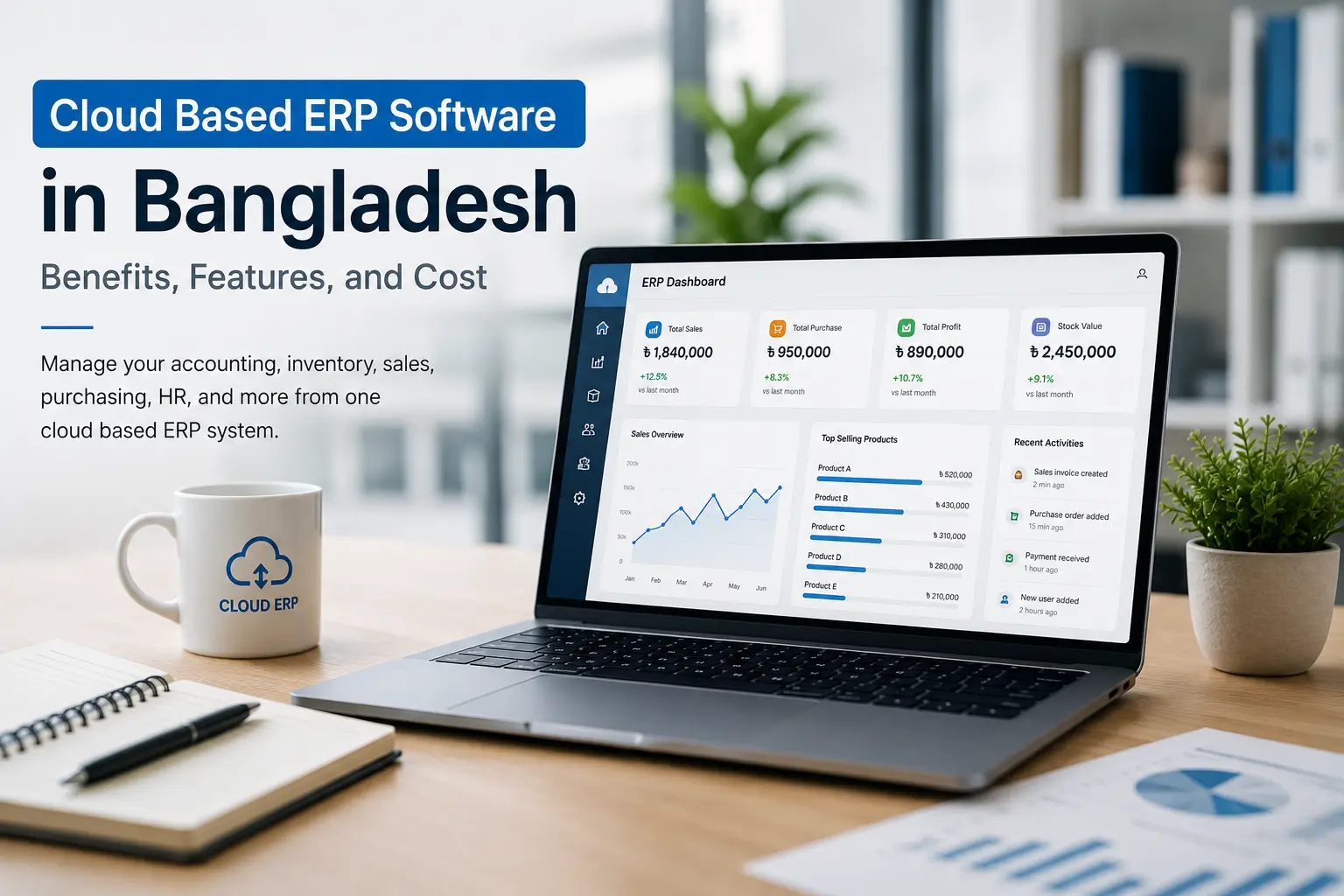
Cloud Based ERP Software in Bangladesh: Benefits, Features, and Cost
Managing a business becomes much harder when everything is handled separately. Sales are recorded in one place, inventory is updated in a spreadsheet, accounts are managed with another software, and employee information may be kept somewhere else. Cloud Based ERP.
At the beginning, this may not seem like a big problem. But as the business grows, keeping all these systems updated becomes time-consuming and creates plenty of opportunities for mistakes.
This is one of the main reasons businesses are looking at cloud based ERP software in Bangladesh.
A cloud ERP system brings different parts of a business together in one platform. Instead of switching between several tools, businesses can manage sales, inventory, accounting, purchasing, HR, payroll, CRM, and reporting from a connected system.
But is cloud ERP really worth the investment? What features should you look for? And how much does ERP software cost in Bangladesh?
Let’s take a closer look.
What Is Cloud Based ERP Software?
ERP stands for Enterprise Resource Planning. In simple terms, ERP software helps a business manage its day-to-day operations through one connected system.
A cloud based ERP works online. The software and business data are hosted on cloud infrastructure, so authorized users can access the system through the internet instead of depending entirely on a computer or server at the office.
For example, imagine a company receives a new customer order.
The sales team records the order. The inventory team can see the stock requirement, the accounts department can track the financial transaction, and management can see the updated sales information in their reports.
Instead of entering the same information several times, the different departments can work with connected data.
That’s where ERP becomes useful.
Why Is Cloud ERP Becoming Popular in Bangladesh?
Many businesses in Bangladesh start small. They may use Excel for inventory, a separate application for accounts, WhatsApp or email for communication, and another system for sales.
There’s nothing wrong with starting this way.
The problem usually appears when the business grows.
You may suddenly have hundreds or thousands of products, several employees, multiple warehouses, different branches, regular purchases, outstanding payments, and a growing customer base.
At that point, finding the right information can become difficult.
A cloud ERP system can bring those operations together so the business has a clearer view of what’s happening.
It can be especially useful for retailers, wholesalers, manufacturers, distributors, service companies, and growing SMEs.
Benefits of Cloud Based ERP Software
Everything in One Place
One of the biggest reasons businesses choose ERP is simple: they don’t want to manage everything separately.
With an integrated ERP system, information about sales, purchases, inventory, accounting, employees, and customers can be managed from one platform.
This makes it easier for different departments to work together.
For management, it also means less time spent collecting information from different employees and files.
Access Your Business From Anywhere
Because cloud ERP is accessed online, authorized users don’t necessarily have to be sitting at the office to check business information.
A business owner travelling outside Dhaka, for example, may still want to check sales or inventory.
Similarly, managers working from different locations can access the information they need, depending on their permissions.
This flexibility is one of the main advantages of cloud-based software.
Better Inventory Control
Inventory problems can become expensive.
Having too much stock ties up money, while running out of popular products can result in lost sales.
An ERP system can help businesses keep track of products, stock movements, purchases, warehouses, and sales from one place.
Instead of trying to match numbers from different spreadsheets, the inventory team can work with a centralized record.
For businesses with a large number of products or multiple warehouses, this can make daily operations considerably easier.
Easier Accounting and Financial Management
Accounting is another area where disconnected systems can cause problems.
When sales, purchases, expenses, and inventory are managed separately from accounts, employees may have to enter the same information more than once.
An ERP system can connect these activities.
Depending on the system and modules selected, businesses can manage invoices, expenses, accounts payable, accounts receivable, financial records, and reports from the same platform.
This doesn’t replace the need for proper accounting practices, but it can make the process more organized.
Real-Time Reports
Business owners don’t want to wait until the end of the month to find out what is happening.
They may want to know:
- How much did we sell today?
- Which products are selling?
- How much stock is available?
- What payments are outstanding?
- How much did we spend?
- Which branch is performing better?
A good ERP system can turn business data into reports and dashboards that make these questions easier to answer.
Sunshine IT’s ERP solution includes reporting and analytics designed to give businesses better visibility into their operations.
Better Control Over Employees
Not every employee needs access to every part of an ERP system.
For example, an accountant may need access to financial information, while a sales employee may only need access to sales and customer-related features.
Cloud ERP systems can use user roles and permissions to control access.
This is particularly important as a company grows and more people start using the system.
Supports Business Growth
The software you use when you have 10 employees may not be enough when you have 50 or 100.
A good ERP system should be able to grow with the business.
You may eventually need more users, additional warehouses, new branches, more products, or additional modules.
Choosing a scalable ERP from the beginning can save the business from having to completely replace its system later.
What Features Should a Cloud ERP System Have?
ERP requirements are different for every business. A retail company doesn’t necessarily need the same features as a manufacturing company.
However, there are several important modules worth looking for.
Accounting and Finance
A strong ERP system should make it easier to manage the financial side of the business.
Depending on the solution, this may include:
- Accounts payable and receivable
- General ledger
- Expense management
- Invoices
- Financial reports
- Cash flow tracking
- VAT-related management
Having accounting connected with sales and purchases can reduce unnecessary manual work.
Inventory Management
For product-based businesses, inventory management is often one of the most important ERP features.
Look for features such as:
- Stock tracking
- Product management
- Warehouse management
- Purchase management
- Stock movement
- Low-stock monitoring
- Inventory reports
If your business has more than one warehouse, make sure the ERP can handle multiple locations properly.
Sales Management
The sales module should help you track customer orders and sales activity.
It may include sales orders, invoices, customer records, sales reports, and integration with POS systems.
When sales information is connected with inventory and accounting, the overall workflow becomes much easier to manage.
Purchase Management
Businesses also need a clear view of what they are buying and from whom.
A purchase management module can help manage suppliers, purchase orders, purchasing records, and supplier payments.
This becomes increasingly important when a business deals with many suppliers.
HR and Payroll
If you have a growing team, managing employee information manually can become a headache.
An ERP with HR and payroll features can help organize employee records, attendance, leave, salary calculations, and payroll information.
It can also reduce repetitive administrative work.
CRM
Customer relationships are another important part of a growing business.
A CRM module can help businesses keep customer information organized and track leads, follow-ups, sales opportunities, and customer interactions.
Instead of keeping customer information in different files or personal devices, the team can work from a shared system.
Reports and Analytics
Reports are where ERP data becomes useful for management.
A good system should make it easy to understand sales, inventory, financial performance, purchases, and other important business information without having to manually prepare everything in Excel.
How Much Does Cloud Based ERP Software Cost in Bangladesh?
This is probably one of the first questions a business owner will ask.
The short answer is: there is no fixed ERP software price in Bangladesh.
The cost depends on what your business needs.
A small company with a few users and basic accounting and inventory requirements will not need the same ERP setup as a large company with multiple branches, warehouses, and customized workflows.
Factors that can affect the cost include:
- Number of users
- ERP modules
- Number of branches or warehouses
- Customization
- Data migration
- Third-party integrations
- Implementation
- Employee training
- Technical support and maintenance
Sunshine IT currently lists ERP packages starting from ৳150,000, with Professional and Enterprise packages listed at ৳350,000 and ৳500,000 respectively. The actual requirement can vary depending on the business and the level of customization needed.
So rather than choosing an ERP simply because it has the lowest price, it makes more sense to look at the total value you’ll get from the system.
ERP Software Price in Bangladesh: What Are You Actually Paying For?
When comparing ERP prices, don’t look only at the software itself.
Ask what is included in the package.
For example, does the price include:
- Installation or deployment?
- Data migration?
- User training?
- Customization?
- Technical support?
- Backup?
- Updates?
- Future maintenance?
A system that appears cheap initially can become expensive if important services are charged separately.
On the other hand, paying more for an ERP that actually fits your business can save considerable time and operational costs over the long term.
Is Cloud ERP Suitable for Small Businesses?
Yes, but the business should have a genuine need for it.
A very small business with only a few products and simple operations may not need a full ERP system yet.
But if you’re already dealing with multiple employees, large inventories, regular purchases, accounting requirements, or several business locations, ERP can start making a lot of sense.
The important thing is not to buy every available module.
Choose the features you actually need today and make sure the system can expand when your business grows.
Cloud ERP vs On-Premise ERP
The main difference is where the system is hosted and how it is accessed.
With cloud ERP, the system is hosted on cloud infrastructure and accessed through the internet.
With on-premise ERP, the software is generally installed on infrastructure controlled by the business.
Cloud ERP is often attractive to businesses that want easier remote access and less dependence on maintaining their own server infrastructure.
On-premise solutions, meanwhile, can make sense for organizations with specific infrastructure, control, or compliance requirements.
The right choice depends on your business rather than simply following the latest trend.
How to Choose the Right ERP Software in Bangladesh
Choosing ERP is not something you should rush.
Before contacting an ERP provider, write down how your business currently works.
For example:
Sales → Purchase → Inventory → Accounts → Reporting
Then identify where the current problems are.
Are stock records inaccurate? Are employees entering the same data multiple times? Is it difficult to track payments? Are you struggling to see the performance of different branches?
Once you know the problems, you can look for an ERP system that actually solves them.
It’s also worth asking the provider about customization, scalability, user permissions, data security, training, backup, support, and future upgrades.
Most importantly, request a proper demonstration before making a decision.
Why Consider Sunshine IT for Cloud ERP?
Sunshine IT provides ERP software solutions for businesses in Bangladesh, with options for different business sizes and requirements.
The system covers areas such as accounting, inventory, sales, purchasing, HR and payroll, CRM, POS, reporting, and other business operations.
Sunshine IT also offers cloud and on-premise ERP options, along with customization, implementation, training, and ongoing technical support.
The company currently highlights more than 12 years of experience, 2,200+ completed projects, and 1,980+ clients.
If your business is currently using several disconnected systems and you’re considering moving to an integrated ERP platform, you can discuss your requirements with Sunshine IT and determine which modules and deployment option are appropriate for your business.
Final Thoughts
Cloud based ERP software is not simply about putting your business software online.
The real benefit comes from connecting different parts of the business so that sales, inventory, accounting, purchasing, employees, customers, and management can work with the same information.
For a growing business in Bangladesh, that can mean less manual work, better visibility, and more control over daily operations.
Before choosing an ERP system, look beyond the price. Consider the features you actually need, how easily the system can grow with your business, the quality of support, and the overall cost of implementation.
If you’re looking for cloud based ERP software in Bangladesh, Sunshine IT can help you explore an ERP solution based on your business size, workflow, and requirements.